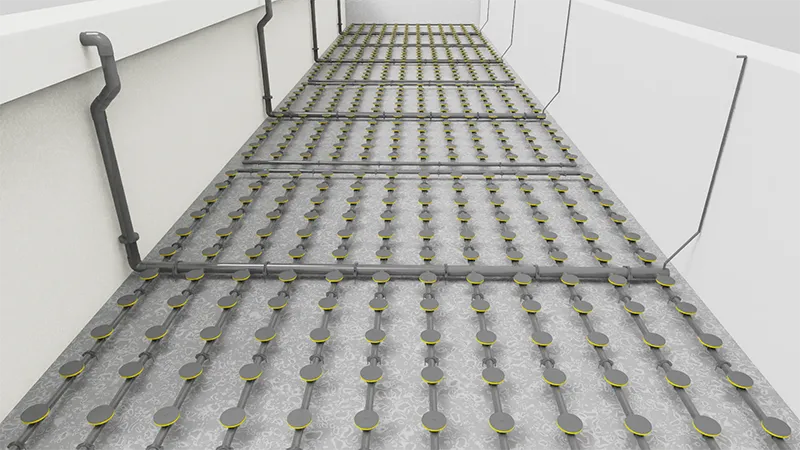
The HINKTON DISK-X fine bubble disc diffuser is engineered for efficient oxygen transfer in municipal and industrial wastewater treatment systems. Its precision-perforated membrane produces a uniform fine-bubble pattern, helping biological treatment systems maintain stable dissolved oxygen while controlling airflow, pressure loss and long-term aeration costs.
The HINKTON DISK-X fine bubble disc diffuser is designed to deliver uniform air distribution and efficient oxygen transfer in municipal and industrial wastewater treatment systems. With precision-perforated membranes, a robust diffuser body and project-specific aeration design support, the DISK-X series provides a reliable solution for both new installations and aeration system upgrades.
HINKTON currently offers two principal sizes:
- DISK-X 270, nominal 9-inch class
- DISK-X 340, nominal 12-inch class
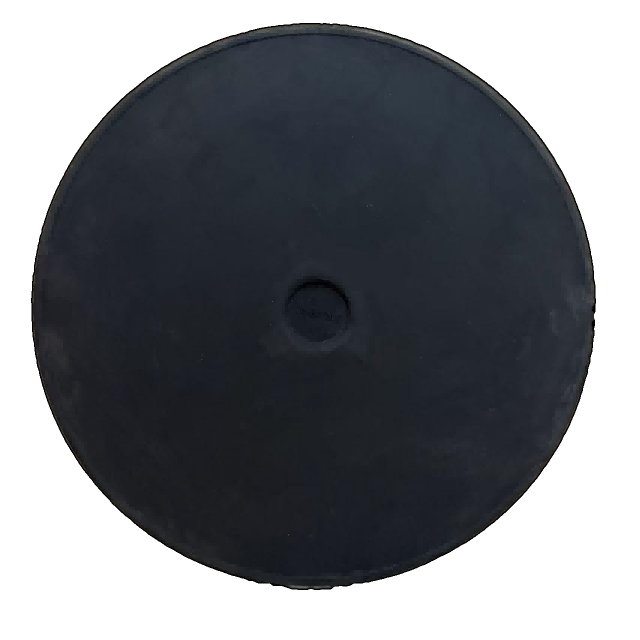
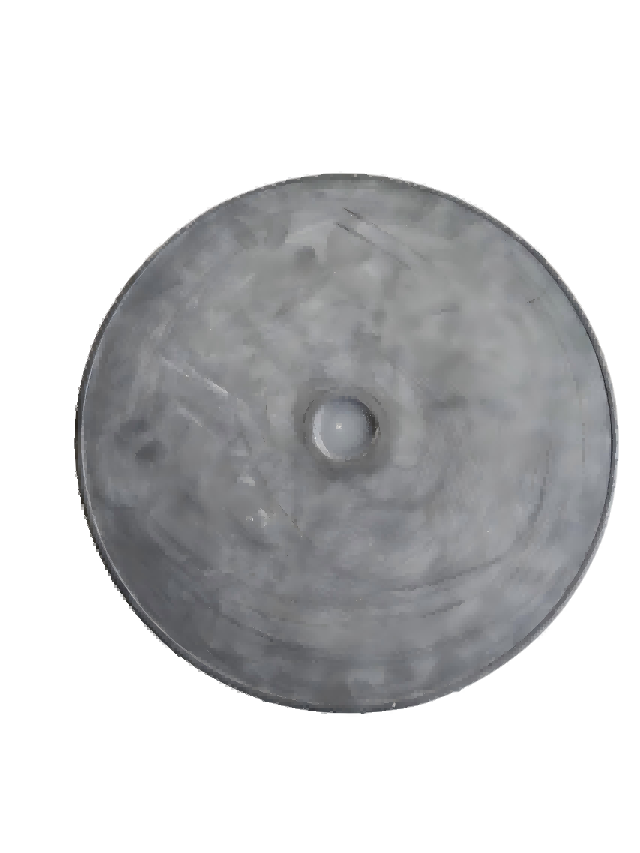
Uniform Fine Bubble Distribution
The DISK-X membrane contains thousands of precision-manufactured slits. When air is supplied, these slits open uniformly to produce fine bubbles across the effective membrane area.
Fine and evenly distributed bubbles increase the contact area between air and wastewater, helping improve oxygen transfer while reducing the airflow required to meet the biological process demand.
When the air supply stops, the membrane closes against the supporting structure. The integrated non-return design helps limit water and sludge ingress into the aeration pipework.
Two Sizes for Different Aeration Requirements
The DISK-X 270 is suitable for aeration grids requiring compact diffuser spacing and flexible airflow distribution. The larger DISK-X 340 provides a greater active membrane area and supports a higher airflow range, making it suitable for larger aeration tanks and applications requiring fewer diffuser units.
Technical Specifications
| Parameter | Unit | DISK-X 270 | DISK-X 340 |
|---|---|---|---|
| Nominal Size | inch class | 9-inch | 12-inch |
| Nominal Diffuser Size | mm | 270 | 340 |
| Effective Membrane Area | m² | 0.0375 | 0.065 |
| Recommended Coverage Area | m² | 0.1875–0.75 | 0.325–1.30 |
| Design Airflow | m³/h | 1.5–6.0 | 2.5–10.0 |
| Recommended Airflow | m³/h | 3.0 | 5.0 |
| Maximum Airflow | m³/h | 9.0 | 15.0 |
| Oxygen Utilization Efficiency* | % | 27–38 | 27–38 |
| Pressure Loss* | Pa | 1,600–2,700 | 1,500–3,000 |
| Theoretical Aeration Efficiency* | kg O₂/kWh | >6.4 | >7.2 |
| Standard Oxygen Transfer Capacity* | kg O₂/h | 0.342 | 0.57 |
| Operating Temperature | °C | 0–80 | 0–80 |
| Air Connection | — | 3/4″ NPT | 3/4″ NPT |
| Membrane Thickness | mm | 2.0 ± 0.1 | 2.0 ± 0.1 |
| Number of Slits | pcs | 6,600 | 11,440 |
| Nominal Slit Length | mm | 1.0 | 1.0 |
| Typical Bubble Diameter | mm | 1–2 | 1–2 |
| Effective Membrane Diameter | mm | 229 | 295 |
*Aeration performance depends on airflow, water depth, wastewater characteristics, diffuser density, pipe arrangement and test conditions.
Verified Membrane Performance
The membrane is a critical component of every fine bubble diffuser. It must maintain its elasticity, slit geometry and mechanical strength during long-term submerged operation.
The HINKTON diffuser membrane has been evaluated for mechanical durability, ageing resistance and compatibility with different operating environments.
Physical Properties
| Property | Test Standard | Measured Result |
|---|---|---|
| Hardness | GB/T 531.1-2008 | 52 ± 5 Shore A |
| Tensile Strength | GB/T 528-2009 | >12 N/mm² |
| Tear Strength | GB/T 529-2008 | >18 N/mm² |
| Elongation at Break | — | >600% |
| Permanent Set After 24 Hours at 100% Elongation | — | <5% |
| Density | — | 1.08 g/cm³ |
The elongation and recovery characteristics help the membrane open consistently during aeration and close after airflow stops. Its tensile and tear resistance support reliable operation under repeated inflation cycles.
Ageing and Chemical Resistance
| Test Item | Test Standard | Measured Change |
|---|---|---|
| Tensile Change After Hot-Air Ageing | GB/T 3512-2014 and GB/T 528-2009 | 7.5% |
| Elongation Change After Acid Exposure | GB/T 1690-2010 and GB/T 528-2009 | 2.0% |
| Elongation Change After Alkali Exposure | GB/T 1690-2010 and GB/T 528-2009 | 6.1% |
| Mass Change After Oil Exposure | GB/T 1690-2010 | 5.9% |
| Mass Change After Deionized-Water Exposure | GB/T 1690-2010 | 0.9% |
| Volume Change After Deionized-Water Exposure | GB/T 1690-2010 | 1.2% |
These measured results demonstrate the membrane’s ability to maintain its principal physical characteristics under representative ageing and exposure conditions.
For industrial wastewater applications, HINKTON evaluates the wastewater composition, temperature, oil content and chemical environment before recommending the appropriate membrane configuration.
Aeration Performance Testing
DISK-X diffuser performance has been evaluated under controlled clean-water conditions at a water depth of 6 metres, a water temperature of 16.5°C and standard atmospheric pressure.
The test results show the expected relationship between airflow, oxygen utilization and pressure loss:
- Oxygen utilization is generally higher at lower specific airflow.
- Pressure loss increases as airflow rises.
- The DISK-X 340 supports a higher airflow while providing a larger effective membrane area.
- Operating within the recommended airflow range provides a better balance between oxygen transfer and system resistance.
Published test curves should be used as engineering references rather than unconditional guarantees. Actual field performance is influenced by water depth, wastewater composition, alpha factor, fouling, diffuser density and blower control strategy.
Applications
HINKTON DISK-X fine bubble disc diffusers can be used in:
- Municipal sewage treatment plants
- Industrial wastewater treatment plants
- Activated sludge systems
- A2/O and modified A2/O processes
- Sequencing batch reactors
- Oxidation ditches
- Biological nutrient removal systems
- Aeration tank construction and expansion projects
- Existing aeration system rehabilitation
- Energy-saving aeration upgrades
More Than a Diffuser Supply
Selecting a diffuser based only on its diameter or maximum airflow can lead to uneven oxygen distribution, excessive pressure loss or inefficient blower operation.
HINKTON provides project-level support covering:
- Oxygen demand calculations
- Diffuser quantity and density selection
- Aeration grid layout
- Airflow distribution calculations
- Header and branch pipe sizing
- Pressure-loss assessment
- Blower operating-point coordination
- Zoned aeration and control strategies
- Retrofit evaluation for existing treatment plants
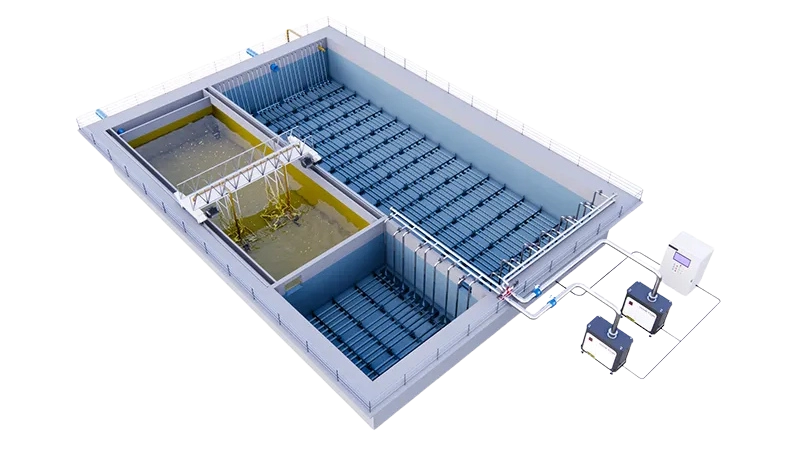
By coordinating the diffuser grid, air piping, blower and biological process requirements, HINKTON helps customers develop an aeration system that is efficient, maintainable and suitable for actual operating conditions.
Why Choose HINKTON DISK-X?
The HINKTON DISK-X series combines verified membrane performance, practical airflow ranges and complete aeration engineering support.
Whether used in a new installation or an existing treatment plant upgrade, the HINKTON DISK-X fine bubble disc diffuser provides a reliable foundation for efficient oxygen transfer, stable biological treatment and manageable long-term operating costs.