Fluoride removal from industrial wastewater is a common challenge in semiconductor, photovoltaic, electroplating, mining and metal-processing industries.
High fluoride concentrations are usually not the hardest part. Conventional chemical treatment can remove a large portion of fluoride relatively easily. The real challenge is often reducing the remaining fluoride to a low and stable discharge level without creating excessive sludge or operating cost.
There is no single best fluoride removal method. The right process depends on fluoride concentration, wastewater composition, flow rate and final discharge or reuse requirements.
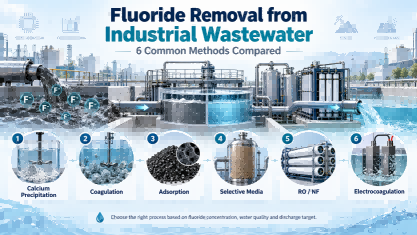
Below are six commonly used technologies.
1. Calcium Precipitation
Calcium precipitation is one of the most widely used methods for high-fluoride wastewater treatment.
Lime or calcium chloride is added to provide calcium ions, which react with fluoride to form calcium fluoride precipitate.
Ca²⁺ + 2F⁻ → CaF₂↓
Advantages
- Mature and simple process
- Relatively low chemical cost
- Suitable for large wastewater volumes
- Effective for high fluoride concentrations
Limitations
The process becomes less effective as fluoride concentration decreases.
It also produces significant amounts of sludge, especially when lime dosage is high.
Best application
High-concentration fluoride wastewater requiring bulk fluoride removal.
2. Coagulation and Precipitation
When calcium precipitation cannot achieve the required final fluoride concentration, aluminum- or iron-based coagulants may be added.
Fluoride can be further removed through adsorption, complexation and co-precipitation with metal hydroxide flocs.
Advantages
- Easy to combine with existing precipitation systems
- Mature industrial application
- Can further reduce fluoride concentration
- Also helps remove suspended solids and some metals
Limitations
Performance depends strongly on:
- pH
- Chemical dosage
- Influent fluoride concentration
- Competing ions
- Mixing conditions
Chemical overdosing can increase sludge and operating cost.
Best application
Medium fluoride concentrations or polishing after calcium precipitation.
3. Adsorption
Adsorption is commonly used for deep fluoride removal after most of the fluoride load has already been removed.
Typical materials include activated alumina, hydroxyapatite, metal oxides and engineered adsorbents.
Advantages
- Suitable for low fluoride concentrations
- Compact equipment
- Low sludge production
- Good polishing performance
Limitations
Adsorbents have limited capacity.
If high-fluoride wastewater enters the adsorption system directly, the media may become exhausted quickly.
Competing ions and pH can also affect performance.
Best application
Low-concentration fluoride polishing after upstream treatment.
4. Selective Fluoride Removal Media
Specialized fluoride-removal media or resins are designed to provide stronger affinity toward fluoride than conventional adsorbents.
They can be useful when very low residual fluoride is required.
Advantages
- Compact footprint
- Good deep-treatment performance
- Lower sludge production
- Can be operated in modular vessels
- Some media can be regenerated
Limitations
The media cost is generally higher than conventional precipitation.
Regeneration also creates a concentrated fluoride-containing waste stream that requires further treatment.
For this reason, selective media is usually more economical after upstream precipitation.
A typical treatment train may be:
Calcium Precipitation → Solid Separation → Selective Fluoride Media → Final Effluent
Best application
Deep polishing, limited-space projects and applications requiring low final fluoride concentration.
5. Reverse Osmosis and Nanofiltration
RO and some NF membrane systems can reduce fluoride together with many other dissolved salts.
Unlike precipitation or adsorption, membrane treatment is particularly attractive when the project also requires water reuse.
Advantages
- High-quality treated water
- Simultaneous removal of multiple dissolved contaminants
- Compact and automated system
- Suitable for industrial water reuse
Limitations
Membranes do not destroy fluoride.
They produce a low-fluoride permeate and a concentrated reject stream containing the removed fluoride.
The concentrate therefore requires additional treatment.
Membrane fouling and scaling may also require substantial pretreatment.
Best application
Wastewater reuse, high-quality effluent production and ZLD-related projects.
6. Electrocoagulation
Electrocoagulation uses iron or aluminum electrodes to generate coagulating species directly in the wastewater.
These hydroxide flocs can capture fluoride and other contaminants.
Advantages
- Compact equipment
- Flexible operating control
- Reduced need for bulk coagulant storage
- Can treat multiple pollutants simultaneously
Limitations
Operating cost depends on:
- Electricity consumption
- Electrode consumption
- Water conductivity
- Electrode passivation
- Cleaning requirements
Electrocoagulation also produces solids, so sludge treatment is still required.
Best application
Complex industrial wastewater, medium flow rates and projects with limited space.
Fluoride Removal Methods Comparison
| Method | Best Use | Main Advantage | Main Limitation |
|---|---|---|---|
| Calcium precipitation | High fluoride | Low-cost bulk removal | High sludge production |
| Coagulation | Medium fluoride | Mature and flexible | Sensitive to pH and dosage |
| Adsorption | Low fluoride | Good polishing ability | Limited media capacity |
| Selective media | Deep polishing | Compact and low sludge | Higher media cost |
| RO / NF | Water reuse | High-quality effluent | Concentrate treatment |
| Electrocoagulation | Complex wastewater | Flexible and compact | Energy and electrode cost |
Which Fluoride Removal Process Should You Choose?
In many industrial wastewater projects, the best solution is not a single process but a combination.
For high fluoride concentrations, chemical precipitation is usually the most economical first step.
For medium concentrations, coagulation can provide additional removal.
For low final fluoride targets, adsorption or selective media can be added as polishing treatment.
If the treated water needs to be reused, membrane systems may become more attractive.
A common approach is:
High-Fluoride Wastewater
→ Calcium Precipitation
→ Coagulation / Solid Separation
→ Deep Fluoride Polishing
This allows low-cost treatment to remove the majority of the fluoride load while more expensive polishing technologies are only used where they are most effective.
Key Factors for Process Selection
Before selecting a fluoride wastewater treatment process, it is important to understand:
- Influent fluoride concentration
- Maximum and average flow
- pH
- Suspended solids
- Hardness
- Sulfate, chloride and other competing ions
- Required final fluoride concentration
- Sludge or concentrate disposal requirements
- Whether the treated water will be discharged or reused
Laboratory testing is recommended when wastewater composition is complex or highly variabl
Can chemical precipitation remove fluoride to very low levels?
Chemical precipitation is effective for bulk fluoride removal, especially at high concentrations, but it may require additional polishing when a very low final fluoride concentration is required.
Is adsorption suitable for high-fluoride wastewater?
Usually not as the first treatment step. High fluoride concentrations can rapidly consume adsorption capacity and increase operating cost.
Can RO remove fluoride?
Yes. RO can significantly reduce fluoride and other dissolved salts, but the fluoride is transferred into the membrane concentrate, which still requires treatment.
What is the best fluoride removal method?
There is no universal best method.
The most suitable solution depends on fluoride concentration, wastewater chemistry, required effluent quality and operating cost.
In many cases, a staged treatment process combining precipitation and deep polishing provides the best balance between performance and cost.