Improve Wastewater Treatment Capacity Through Intelligent Sludge Selection
HINKTON DAS™ (Dense Activated Sludge) is an advanced sludge optimization technology designed to improve the settling performance, biomass retention and treatment capacity of existing activated sludge systems.
By selectively retaining dense, high-activity sludge and removing low-performance biomass, DAS™ helps wastewater treatment plants achieve higher MLSS concentration, better sludge settleability and more stable biological treatment performance — without major plant expansion.
Why DAS™ Technology?
Many wastewater treatment plants face operational challenges such as:
- Poor sludge settling performance
- High SVI and sludge bulking
- Limited biological treatment capacity
- Unstable nitrogen and phosphorus removal
- Insufficient space for plant expansion
Conventional activated sludge systems cannot easily maintain a high concentration of functional microorganisms because poorly settling sludge and active biomass are discharged together.
DAS™ introduces a controlled sludge selection process to improve sludge quality and system stability.
How Does DAS™ Work?
DAS™ combines three key mechanisms:
1. Biological Selection
Through optimized anaerobic, anoxic and aerobic conditions, DAS™ promotes the formation of stronger microbial aggregates and denser sludge structures.
This creates favorable conditions for:
- Nitrifying bacteria
- Denitrifying bacteria
- Phosphorus-accumulating organisms
2. Density-Based Sludge Selection
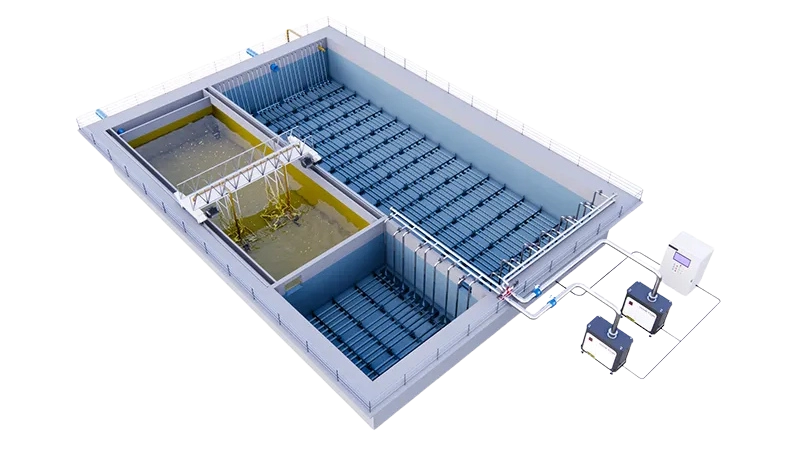
The InDENSE™ sludge selection system separates sludge according to density and settling characteristics.
Dense Sludge Retention
High-density sludge is returned to the biological reactor, allowing:
- Higher biomass retention
- Better settling performance
- More stable biological treatment
Light Sludge Removal
Low-density sludge fractions, including poorly settling and aged sludge, are selectively removed to prevent accumulation.
3. Intelligent Process Control
DAS™ operation is supported by intelligent monitoring and control of key parameters, including:
- Sludge concentration
- Dissolved oxygen
- Sludge return flow
- Selection system operation
This ensures stable performance under changing influent conditions.
Key Benefits of DAS™
Improved Sludge Settleability
DAS™ promotes denser sludge formation, helping:
- Reduce SVI
- Minimize sludge carryover
- Improve secondary clarifier performance
Increased Treatment Capacity
By increasing biomass concentration and improving sludge retention, DAS™ can help existing wastewater treatment plants increase effective biological capacity without constructing additional tanks.
For suitable applications, capacity improvement of approximately 30–50% may be achievable.
Enhanced Nutrient Removal
Better retention of functional microorganisms supports more stable:
- Ammonia removal
- Nitrification
- Denitrification
- Biological phosphorus removal
Higher Process Stability
The dense sludge structure improves resistance to:
- Hydraulic fluctuations
- Organic load variations
- Temperature changes
- Industrial wastewater impacts
DAS™ Applications
DAS™ is suitable for upgrading existing continuous-flow biological treatment systems, including:
- Modified AAO process
- Conventional activated sludge
- Oxidation ditch
- Step-feed activated sludge
- Industrial wastewater treatment systems
Typical applications:
✓ Capacity expansion without new biological tanks
✓ Sludge bulking control
✓ Poor settling improvement
✓ Nutrient removal enhancement
✓ Existing WWTP retrofit projects
DAS™ vs Conventional Activated Sludge
| Conventional Activated Sludge | HINKTON DAS™ | |
|---|---|---|
| Sludge selection | Limited | Controlled density selection |
| Sludge settling | Variable | Improved |
| Biomass retention | Average | Higher |
| MLSS concentration | Limited | Increased |
| Expansion requirement | Often requires new tanks | Retrofit possible |
| Process stability | Sensitive to fluctuations | More stable |
Frequently Asked Questions
Is DAS™ the same as aerobic granular sludge?
No. DAS™ is not a traditional aerobic granular sludge system.
It creates dense activated sludge with improved settling characteristics, positioned between conventional activated sludge and mature aerobic granules.
Can DAS™ upgrade existing wastewater plants?
Yes. DAS™ is designed for retrofit applications and can be integrated into existing biological treatment systems with limited structural modification.
Can DAS™ reduce plant expansion requirements?
In suitable projects, DAS™ can increase biological treatment capacity by improving biomass retention and sludge settleability, reducing the need for additional biological tanks.
Can DAS™ control sludge bulking?
DAS™ helps reduce poorly settling sludge fractions through selective removal. However, underlying causes such as oxygen deficiency, nutrient imbalance and excessive loading should also be addressed.