Selecting the right blower is one of the most important decisions in the design or upgrade of a wastewater aeration system. The blower must provide sufficient airflow and pressure for biological treatment while working efficiently with the diffusers, air headers, branch pipes, valves and control system.
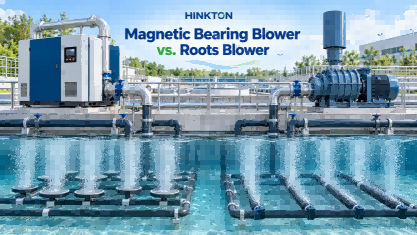
Two common choices are the magnetic bearing turbo blower and the Roots blower. Each technology has its own advantages. The best solution depends on the required airflow, operating pressure, load variation, annual operating hours, site conditions and total life-cycle cost.
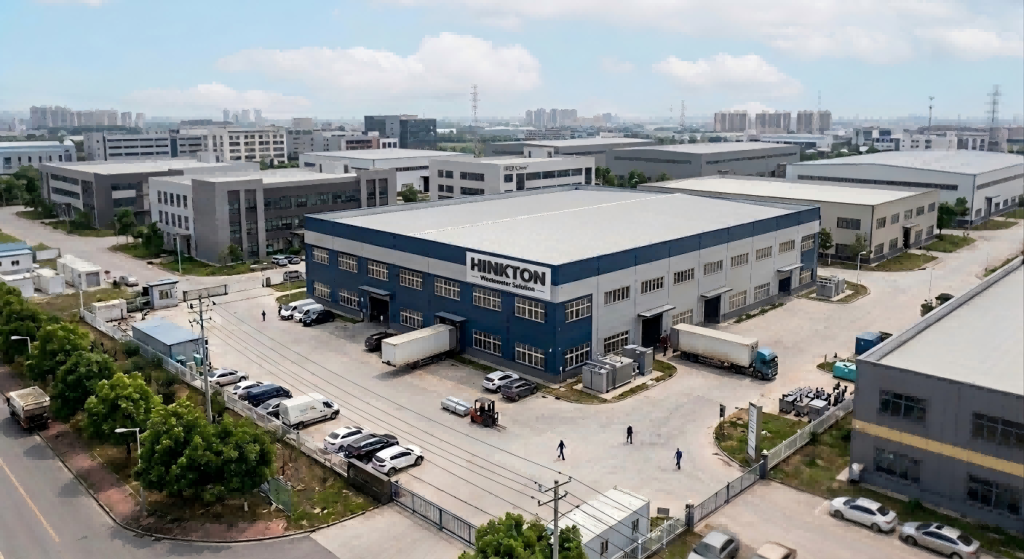
As a wastewater aeration solution provider, HINKTON supports municipal wastewater treatment plants, industrial wastewater facilities, EPC contractors and engineering companies with aeration equipment selection, airflow evaluation, diffuser arrangement, pipeline configuration and aeration system retrofit recommendations.
Magnetic Bearing Turbo Blower vs. Roots Blower
Roots Blower
A Roots blower is a positive-displacement blower that delivers air through the rotation of two lobed rotors. It is widely used in sewage treatment and industrial effluent treatment because of its simple structure and stable airflow.
Its main advantages include:
- Relatively low initial investment
- Mature and proven technology
- Simple operation and maintenance
- Good adaptability to pressure variations
- Easy access to spare parts and repair services
However, Roots blowers generally produce more noise and vibration. Under continuous operation, their energy consumption may also be higher than that of a properly selected high-efficiency turbo blower.
Roots blowers are commonly suitable for small and medium-sized wastewater treatment plants, intermittent aeration systems and projects with limited initial budgets.
Magnetic Bearing Turbo Blower
A magnetic bearing turbo blower uses a high-speed centrifugal impeller and an actively controlled magnetic bearing system. Because there is no mechanical contact between the rotating shaft and the bearing during normal operation, the blower offers low vibration, oil-free air delivery and reduced routine maintenance.
Its main advantages include:
- High efficiency within the appropriate operating range
- Low noise and vibration
- Oil-free operation
- Compact design
- Variable-speed airflow control
- Reduced routine maintenance requirements
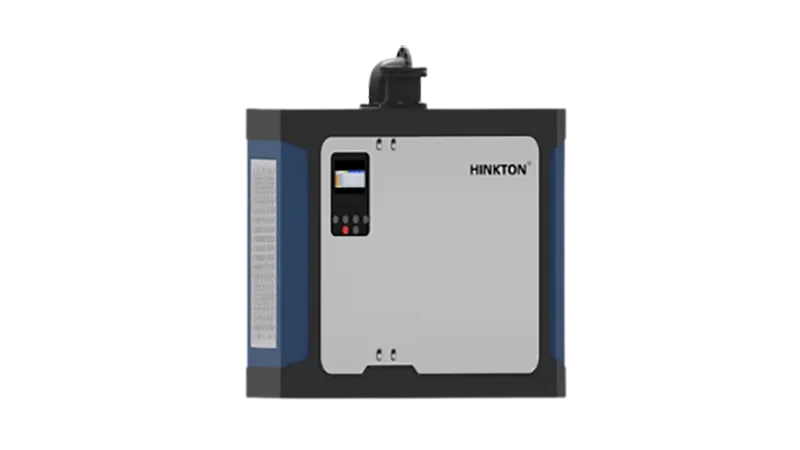
The HINKTON-Turbo magnetic blower is designed for wastewater aeration applications requiring efficient and stable compressed air delivery. When properly matched with fine bubble diffusers and intelligent dissolved oxygen control, it can form part of an energy-efficient aeration solution.
However, a magnetic bearing blower should not be selected solely because it is considered advanced technology. Its performance range, minimum airflow, inlet conditions, power quality and service support must all be evaluated.
Key Factors in Blower Selection
1. Required Airflow
The blower airflow should be calculated according to the oxygen demand of the biological treatment process.
Important factors include:
- Wastewater treatment capacity
- Influent BOD, COD and ammonia concentration
- Required dissolved oxygen level
- Maximum, average and minimum process load
- Number and type of aeration diffusers
- Design airflow per diffuser
- Seasonal and daily load variation
A small plant with relatively low airflow demand may be more economically served by a Roots blower. A medium or large wastewater treatment plant operating continuously may benefit more from a magnetic bearing turbo blower.
The blower should not be selected according to maximum airflow alone. Its efficiency under normal and minimum operating conditions is equally important.
2. Required Discharge Pressure
The required pressure can be summarized as:
Required blower pressure = water depth pressure + diffuser pressure loss + piping and valve losses + reasonable safety margin
The calculation should consider:
- Effective aeration tank water depth
- Diffuser membrane resistance
- Main header and branch pipe dimensions
- Pipe length and number of fittings
- Valve and check valve pressure losses
- Future diffuser fouling
- Site elevation and atmospheric conditions
An oversized blower wastes energy, while an undersized blower may fail to provide sufficient oxygen. For a magnetic bearing centrifugal blower, all expected duty points should be checked against the manufacturer’s blower performance curve.
3. Annual Operating Hours
Operating time has a major influence on the economic comparison.
If a blower operates for only a few hours per day, the lower purchase cost of a Roots blower may be more attractive. If the blower operates continuously for 16 to 24 hours per day, the potential electricity savings from a high-efficiency turbo blower become more important.
The comparison should be made using actual input power under the same airflow and pressure conditions—not simply the rated motor power.
4. Load Variation and Control Range
Municipal and industrial wastewater loads often vary throughout the day. Industrial plants may also experience production shutdowns, batch discharges and seasonal changes.
The blower selection should therefore consider:
- Minimum stable airflow
- Variable-frequency control range
- Partial-load efficiency
- Centrifugal blower surge limits
- Dissolved oxygen control strategy
- Duty and standby arrangement
For plants with a wide airflow range, multiple smaller blowers may provide better operational flexibility than one oversized blower.
Why the Complete Aeration System Matters
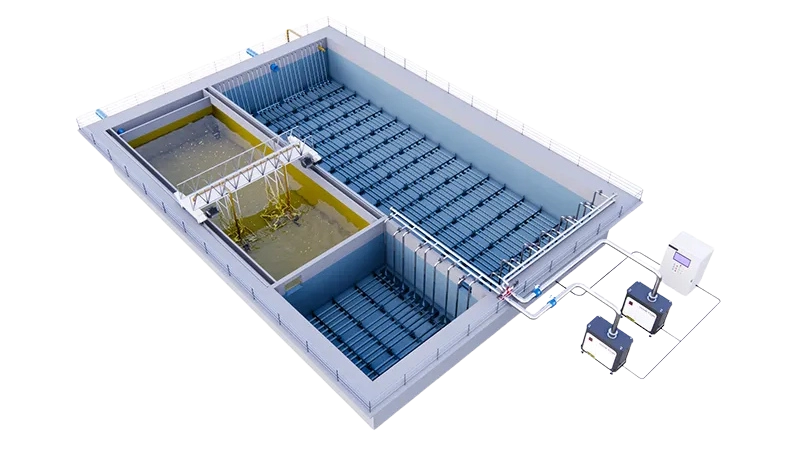
The blower is only one component of an efficient wastewater aeration system. Even a highly efficient blower cannot achieve the expected result if the diffusers are fouled, the pipe diameter is too small or the airflow distribution is uneven.
A complete aeration system should integrate:
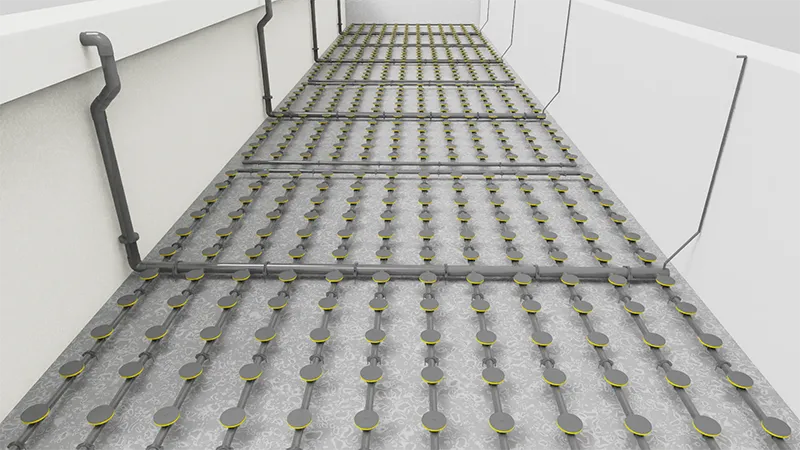
- Fine bubble disc diffusers
- Fine bubble tube diffusers
- Retrievable aeration systems
- Stainless-steel aeration discs
- UPVC or HDPE air headers and branch pipes
- Stainless-steel threaded fittings
- Adjustable supports
- Floating aeration assemblies
- Valves and airflow-control accessories
- Dissolved oxygen instruments and automatic control
HINKTON approaches wastewater aeration from a system perspective. Its product portfolio includes the Disk-X® disc aeration diffuser, Aerts-X® tube aeration diffuser, Retro-X® retrievable aeration system and HINKTON-Turbo magnetic blower.
Depending on the project requirements, diffuser components can use materials such as EPDM membranes, ABS engineering plastics, stainless steel and corrosion-resistant pipeline materials.
Disc Diffuser or Tube Diffuser?
Both disc and tube diffusers are widely used for fine bubble aeration.
Fine Bubble Disc Diffusers
Disc diffusers are commonly used in municipal sewage treatment plants and industrial wastewater aeration tanks. They can provide uniform air distribution when installed with a properly designed bottom-fixed piping grid.
They are suitable for:
- Activated sludge processes
- A/O and A²/O systems
- SBR treatment tanks
- MBBR and IFAS systems
- New wastewater treatment plants
- Existing plant upgrades
Fine Bubble Tube Diffusers
Tube diffusers provide a relatively large membrane surface and can be arranged flexibly within an aeration basin.
They are often considered for:
- Industrial wastewater treatment
- Long and narrow aeration tanks
- High airflow applications
- Retrofit projects
- Systems requiring flexible diffuser density
The final choice should be based on oxygen demand, tank geometry, water depth, wastewater characteristics, maintenance requirements and available airflow.
Retrievable Aeration Systems for WWTP Retrofit
For an existing wastewater treatment plant, draining the aeration tank may interrupt production and create substantial operational costs.
A retrievable aeration system allows diffuser assemblies to be lifted for inspection, cleaning or replacement under suitable project conditions. This makes it especially useful for:
- Wastewater treatment plant retrofit projects
- Industrial plants that cannot stop production
- Deep aeration tanks
- Projects requiring easier maintenance
- Existing systems with damaged or blocked diffusers
The HINKTON Retro-X® retrievable aeration solution can be evaluated according to tank dimensions, operating conditions and maintenance requirements.
How HINKTON Supports Aeration Projects
HINKTON provides aeration equipment and engineering support for municipal and industrial wastewater treatment projects.
Depending on the information available, project support may include:
- Reviewing wastewater capacity and biological treatment requirements
- Estimating oxygen demand and total airflow
- Selecting suitable disc or tube diffusers
- Calculating diffuser quantity and airflow per unit
- Developing diffuser arrangement recommendations
- Evaluating main and branch air-pipe configurations
- Calculating system pressure requirements
- Matching the blower with the aeration network
- Reviewing retrofit and maintenance requirements
- Providing complete equipment supply and technical coordination
This integrated approach helps ensure that the blower, diffusers, piping and control system operate as one coordinated wastewater aeration solution.
Which Blower Should You Choose?
A Roots blower may be more suitable when:
- The wastewater treatment system is relatively small
- Initial investment is limited
- Operating hours are short or intermittent
- Airflow demand is relatively low
- Site conditions are challenging
- Simple local maintenance is a priority
A magnetic bearing turbo blower should be evaluated when:
- The treatment plant is medium or large
- Airflow demand is high
- The blower operates continuously
- Electricity consumption is a major operating cost
- Low noise and vibration are required
- The equipment room has suitable ventilation and filtration
- Long-term energy efficiency is a project priority
Neither blower should be selected without checking actual airflow, pressure and operating conditions.
Frequently Asked Questions
What information is required to size a wastewater aeration blower?
The main information includes treatment capacity, wastewater characteristics, biological process, tank dimensions, effective water depth, diffuser type, required airflow, piping layout and daily operating hours.
Can a magnetic bearing blower directly replace a Roots blower?
Not always. The existing airflow, pressure, pipe resistance, control system and minimum operating requirements must be reviewed before replacement.
How can an aeration system reduce energy consumption?
Common methods include matching the blower to actual demand, using efficient fine bubble diffusers, reducing pipeline pressure losses, cleaning fouled membranes, applying variable-speed control and adjusting airflow according to dissolved oxygen demand.
When should aeration diffusers be replaced?
Diffusers should be inspected when system pressure increases, bubbles become uneven, oxygen transfer performance declines or the blower must deliver more air to maintain the same dissolved oxygen level.
Can HINKTON provide a complete aeration system?
HINKTON can support project-specific solutions involving aeration diffusers, air piping, fittings, supports, valves, blower selection and technical coordination for municipal and industrial wastewater applications.
Conclusion
The choice between a magnetic bearing turbo blower and a Roots blower should be based on the complete wastewater aeration system—not on equipment price alone.
For reliable and energy-efficient operation, engineers must evaluate oxygen demand, airflow variation, water depth, diffuser resistance, piping losses, blower efficiency, maintenance conditions and standby requirements.
HINKTON combines fine bubble aeration equipment, blower technology and project-specific engineering support to help customers develop practical aeration solutions for new wastewater treatment plants and existing WWTP upgrades.
Planning a municipal or industrial wastewater aeration project? Contact HINKTON with your treatment capacity, tank dimensions, water depth, existing diffuser information and blower operating conditions for technical evaluation and quotation support.