
Replacing tube diffusers without draining the tank can be challenging when a wastewater treatment plant must remain in continuous operation, especially in MBBR systems where aeration is required for both oxygen transfer and carrier movement.
This is particularly challenging in MBBR systems, where continuous aeration is required not only for oxygen transfer but also to maintain effective carrier movement and biological treatment.
A recent project inquiry received by HINKTON involved exactly this situation: some existing tube diffusers had stopped operating, while the treatment plant needed to remain online. The aeration tank contained MBBR carriers and had a water depth of approximately 6 meters.
Instead of immediately draining the tank and replacing the entire fixed aeration system, several retrofit approaches can be considered.
Why Do Tube Diffusers Stop Aerating?
Partial loss of aeration does not necessarily mean that the complete aeration system has failed.
Typical causes may include:
- Membrane fouling or scaling
- Aging or damaged diffuser membranes
- Blocked air distribution pipes
- Damaged connections
- Uneven airflow distribution
- Valve or branch-pipe problems
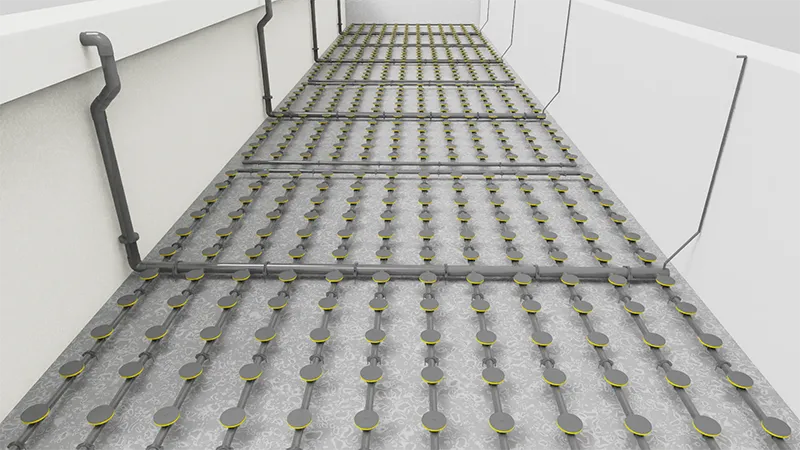
When the affected diffusers are permanently installed on the tank floor, conventional maintenance normally requires the tank to be drained.
For continuously operating wastewater treatment plants, however, shutdown may not be practical.
Option 1: Retrievable Aeration System
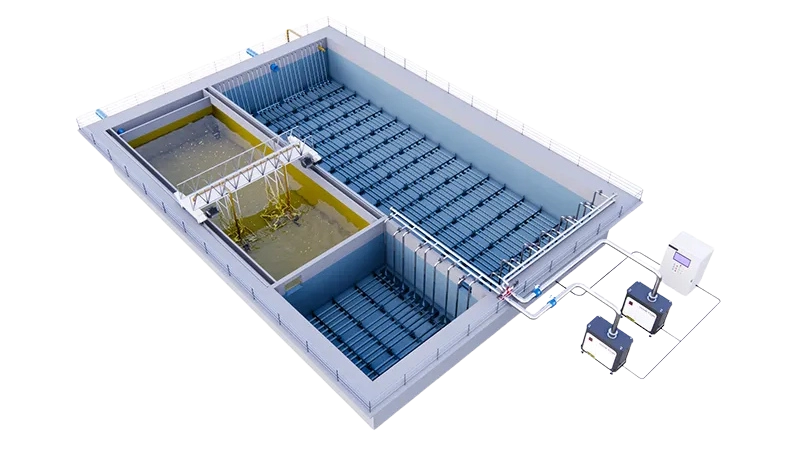
A retrievable aeration system allows diffuser assemblies to be installed and removed from the top of the tank.
The system can provide an alternative to conventional fixed-bottom aeration where future maintenance without tank drainage is an important requirement.
Retrievable systems are particularly useful for retrofit projects where wastewater treatment must remain in operation during installation or maintenance.
Option 2: Modular Tube Diffuser Installation
For localized aeration failure, modular tube diffuser assemblies can provide another retrofit approach.
Instead of installing individual diffusers directly onto the existing tank floor pipework, several tube diffusers can be assembled on an independent support frame outside the tank.
The module can include:
- Fine bubble tube diffusers
- Air distribution piping
- Independent air connection
- Support frame
- Ballast or anchoring components
- Lifting components
The assembled module can then be lowered into the operating tank from above and connected to an available air supply.
This approach may allow additional aeration capacity to be installed in areas where existing diffusers have lost performance without requiring complete tank drainage.
Option 3: Supplemental Aeration Before Scheduled Maintenance
In some projects, the objective is not to permanently replace the existing aeration system.
Instead, additional aeration modules can be used to temporarily restore oxygen transfer and mixing capacity until the wastewater treatment plant reaches its next scheduled maintenance shutdown.
At that time, the original bottom-mounted diffuser system can be inspected and repaired.
This approach can be considered where maintaining biological treatment performance is the immediate priority.
Special Considerations for MBBR Tanks
Adding aeration equipment to an operating MBBR tank requires additional engineering consideration.
Because plastic carriers continuously move inside the reactor, the retrofit system should minimize potential interference between carriers, diffuser components, air hoses and structural supports.
The module should therefore be designed with appropriate protection, positioning and fixing arrangements.
Air distribution is also important. Aeration in an MBBR reactor contributes to both oxygen transfer and carrier movement. Adding air only to one localized area may restore oxygen supply but can also change the original hydraulic and mixing pattern.
For this reason, diffuser quantity and positioning should be evaluated against the existing tank configuration.
What About a 6-Meter Water Depth?
A 6-meter water depth can provide favorable conditions for oxygen transfer because bubbles have a relatively long contact path through the wastewater.
However, deeper installation also increases the required air pressure.
At 6 meters of submergence, static water pressure alone is approximately 59 kPa. The blower must additionally overcome diffuser pressure loss, pipe friction, valves and other system losses.
Before adding new aeration modules, the available blower capacity should therefore be checked.
Key information includes:
- Available blower airflow
- Blower discharge pressure
- Existing operating pressure
- Existing diffuser quantity
- Tank dimensions and water depth
- MBBR carrier filling ratio
- Current DO distribution
- Location of failed aeration zones
HINKTON Modular Aeration Retrofit Solution
For wastewater treatment plants where tank drainage or shutdown is difficult, HINKTON can configure modular aeration assemblies according to the existing tank arrangement.
Tube diffusers, air distribution piping, support structures and lifting components can be pre-assembled into modular units before installation.
The objective is to reduce on-site installation work and provide a practical way to add or restore aeration capacity in an operating treatment tank.
Depending on the project conditions, modular units can be designed either as supplemental aeration equipment or as part of a longer-term retrievable aeration solution.
Before Selecting a Retrofit Solution
There is no universal diffuser quantity for this type of project.
Before selecting a solution, the existing aeration failure should first be diagnosed and the available air supply verified.
For MBBR tanks in particular, diffuser arrangement should be evaluated together with oxygen demand, carrier movement, tank geometry and existing airflow distribution.
A properly engineered retrofit can help restore aeration capacity while reducing the need for immediate tank shutdown.