
Managing Variable Wastewater Loads Across Industrial Parks
Industrial park wastewater treatment is different from treating wastewater generated by a single production facility. A centralized WWTP may receive effluent from food processing, textile, chemical, electronics, pharmaceutical or other manufacturing plants, depending on the industries located within the park.
Even when individual factories provide pretreatment, the combined wastewater entering the central treatment plant can still vary in flow, organic load, nutrient concentration and biodegradability.
These variations place additional demands on the biological treatment and aeration system. The plant must provide enough oxygen during peak loading while avoiding unnecessary aeration during lower-load periods.
Key Challenges in Industrial Park Wastewater Treatment
Variable Influent Loads
Wastewater characteristics can change with factory production schedules, batch discharges and seasonal manufacturing activities.
The performance of industrial park wastewater treatment systems is strongly influenced by variations in wastewater sources, pollutant loads and factory operating schedules.
Typical variations may include:
- COD and BOD loading
- Ammonia and total nitrogen
- Wastewater flow
- Biodegradability
- pH and temperature
- Potential inhibitory compounds
For the biological treatment process, these fluctuations can translate directly into changing oxygen demand and operating conditions.
Shock Loads and Biological Stability
Sudden industrial discharges can temporarily increase organic loading or introduce substances that inhibit biological activity.
The aeration system alone cannot solve toxicity or influent control problems. However, adequate oxygen transfer, good mixing and stable biomass retention can help the biological process respond more effectively to recoverable load fluctuations.
Capacity Expansion Requirements
As industrial parks continue to develop, wastewater flow and pollutant loads may increase.
Existing treatment plants may need to improve biological capacity without major civil expansion.
Uneven Oxygen Demand
When influent conditions change, oxygen demand does not remain constant.
An aeration system designed only around a single operating point may result in either insufficient dissolved oxygen during peak loads or excessive aeration during low-load periods.
For industrial park WWTPs, diffuser capacity, airflow distribution and blower operating range should therefore be evaluated together.
Aeration Design for Variable Industrial Wastewater
Flexible Oxygen Supply
In industrial park wastewater treatment, aeration demand should be evaluated against both average and peak biological loading rather than wastewater flow alone.
Depending on the treatment process, important design inputs may include:
- Wastewater flow and load variation
- COD/BOD and ammonia loading
- Biological treatment process
- Aeration tank dimensions and water depth
- Existing diffuser arrangement
- Available blower airflow and pressure
- Required operating turndown
For existing plants, HINKTON can also evaluate whether the current blower and diffuser system has sufficient operating flexibility before recommending equipment replacement.
Uniform Air Distribution
Adding more air does not necessarily improve treatment performance.
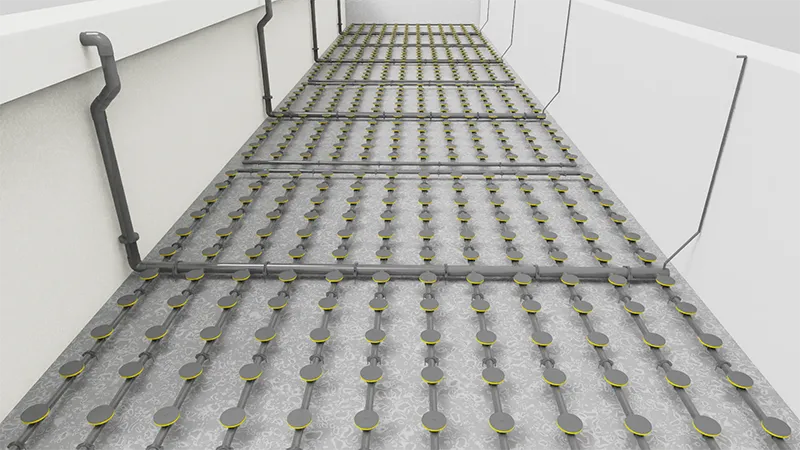
Poor diffuser layout or unbalanced air distribution can create local low-DO zones while other areas receive more air than the biological process requires.
A properly designed aeration system should consider diffuser density, lateral arrangement, airflow per diffuser, pressure loss and tank geometry together.
Aeration Retrofit for Existing Industrial Park WWTPs
Older industrial park treatment plants may experience declining aeration performance due to membrane aging, fouling, uneven air distribution or changes in wastewater loading.
Depending on the existing tank and operating requirements, retrofit options may include:
- Disc or tube diffuser replacement
- Fine-bubble hose aeration
- Retrievable aeration systems
- Air distribution modification
- Blower and diffuser matching
- Aeration layout optimization
Where shutdown is difficult, retrievable aeration configurations can also be considered to simplify inspection and maintenance.
HINKTON Solutions for Industrial Park WWTPs
Fine Bubble Aeration Systems
HINKTON provides fine bubble aeration systems for new-build and retrofit industrial wastewater treatment projects, including:
Disk-X® Disc Diffusers
For conventional fixed-grid fine bubble aeration systems.
Tube Diffusers
Suitable for different tank layouts and retrofit requirements.
Retro-X® Retrievable Aeration System
Designed for applications where easier maintenance and system accessibility are required.
Biological Treatment Capacity Upgrades
Aeration is only one part of biological treatment performance.
Where the main limitation is insufficient biomass concentration, poor sludge settleability or biological reactor capacity, HINKTON can evaluate process upgrade options such as:
MBBR / IFAS
Additional biofilm carriers can increase retained biomass within the existing biological reactor and support higher treatment loads.
DAS™ Dense Activated Sludge
For suitable activated sludge systems, DAS™ can improve sludge selection and biomass retention, supporting better settling performance and higher biological treatment capacity.
These technologies can be combined with aeration system optimization when both oxygen transfer and biological capacity need to be addressed.
New Industrial Park WWTPs
For newly developed industrial parks, wastewater characteristics may continue to change as new factories begin operation.
Aeration systems should therefore allow sufficient capacity and operating flexibility for future loading conditions without unnecessarily oversizing equipment during the initial stage.
HINKTON can support diffuser selection, aeration layout, airflow calculation and future expansion considerations during the design stage.
Existing WWTP Upgrades
For operating industrial parks, the first step should be identifying the actual system bottleneck.
Typical issues may include aging diffusers, insufficient oxygen transfer, excessive blower energy consumption, poor sludge settling or increasing biological loading.
Based on operating data and existing equipment conditions, HINKTON can evaluate whether the project requires aeration retrofit, biological process enhancement or a combination of both.
Engineering Support from HINKTON
Industrial wastewater aeration systems should be designed around actual process conditions rather than diffuser quantity alone.
HINKTON supports EPC contractors, consultants and wastewater treatment plant operators with:
- Oxygen demand assessment
- Airflow calculation
- Diffuser selection
- Aeration layout design
- Blower airflow and pressure evaluation
- Existing aeration system assessment
- Retrofit recommendations
- Biological upgrade evaluation
Effective industrial park wastewater treatment requires coordinated consideration of aeration performance, biological capacity and changing wastewater loads. HINKTON supports project-specific evaluation to identify practical upgrade options for both new and existing treatment plants.
Have an Industrial Park Wastewater Project?
Send us your wastewater flow, influent characteristics, treatment process, aeration tank dimensions and existing blower information. Our engineering team can review the operating conditions and recommend a suitable aeration or biological upgrade approach.
Request Technical Evaluation