Reliable fine-bubble aeration solutions for fiber-rich, high-load wastewater—from new treatment plants to retrofit projects without interrupting wastewater treatment operations.
Wastewater Treatment Challenges in Asia’s Pulp and Paper Industry
Asia’s pulp and paper industry includes integrated pulp mills, recycled-paper mills, packaging-paper manufacturers, tissue mills and specialty-paper producers. The characteristics of wastewater can vary significantly according to the raw material, pulping method, bleaching process, paper grade and internal water-recycling system.
Paper mill wastewater may contain fibers, suspended solids, biodegradable organic matter, lignin derivatives, resin acids, color-producing compounds and papermaking chemicals. These contaminants create fluctuating COD and BOD loads while increasing the risk of sedimentation, fouling and unstable biological treatment performance.
At the same time, mills are under increasing pressure to reduce freshwater consumption, improve process-water recovery, meet discharge requirements and maintain continuous production. This makes the reliability and energy efficiency of the biological aeration system especially important.
Why Aeration Is a Critical Part of Paper Mill Wastewater Treatment
01. High and Variable Organic Loads
High COD and BOD Loads
Organic loads can change with raw materials, production schedules, paper grades, chemical dosing and water-recycling rates. Sudden load increases may cause dissolved oxygen to fall rapidly, affecting biological treatment stability and final effluent quality.
02. Fibers and Suspended Solids
Fiber-Rich Wastewater Increases Fouling Risks
Residual fibers, fillers and suspended solids may accumulate around poorly arranged aeration equipment, pipelines and low-flow areas. Without suitable pretreatment, mixing and aeration distribution, deposits can reduce effective tank volume and increase maintenance requirements.
03. Difficult Oxygen Transfer Conditions
Actual Tank Conditions Differ from Clean Water
Oxygen transfer performance in paper mill activated sludge is affected by wastewater characteristics, mixed-liquor concentration, temperature, surfactants, tank depth and diffuser condition. A system selected only according to clean-water data may not provide the required field performance.
04. High Aeration Energy Consumption
Aeration Is a Major Operating Cost
Aeration is often one of the largest electricity consumers in biological wastewater treatment. Oversized air supply, poor oxygen transfer, blocked diffusers and unsuitable control strategies can create substantial long-term operating costs.
05. Maintenance of Bottom-Mounted Systems
Fixed Systems Can Be Difficult to Access
Conventional bottom-mounted diffuser grids normally require the tank to be drained before inspection, cleaning or replacement. For mills that operate continuously, arranging a shutdown may be difficult and costly.
06. Limited Shutdown Windows
Treatment Operations Cannot Be Easily Interrupted
Many existing mills need to upgrade treatment capacity while keeping the wastewater treatment plant in operation. Retrofit solutions must therefore consider installation access, existing blowers, operating water level, pipeline routing and safe maintenance procedures.
HINKTON Aeration Solutions for Pulp and Paper Wastewater
HINKTON provides aeration equipment and system engineering for both new pulp and paper wastewater treatment plants and existing biological treatment facilities.
Our work covers diffuser selection, air distribution, pipeline arrangement, operating pressure evaluation, blower matching and maintainability planning. Rather than selecting a diffuser based only on catalog data, we develop the aeration arrangement around the actual tank and wastewater conditions.
Fine-Bubble Aeration for New Treatment Plants
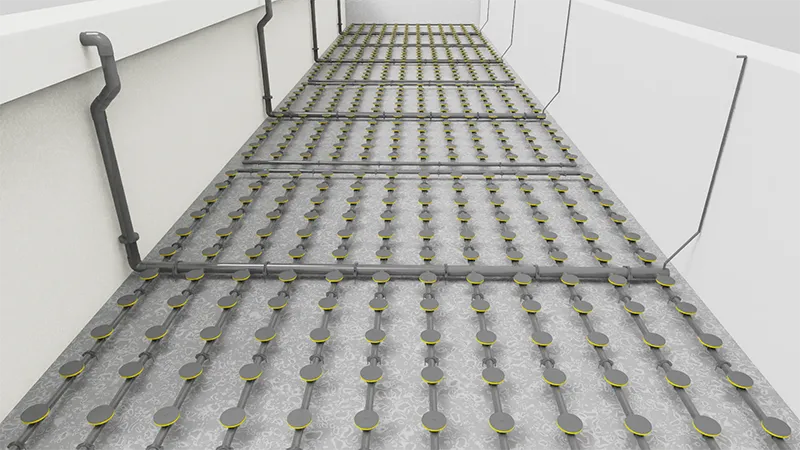
For new aeration tanks, HINKTON designs the diffuser density, air distribution zones, header arrangement and maintenance access according to oxygen demand, tank geometry, water depth and operating conditions.
Fine-bubble aeration can provide a large gas–liquid contact area while distributing oxygen across the biological reactor. The final configuration may use disc, tube or hose diffusers depending on the treatment process and site requirements.
Liftable Aeration for Existing Paper Mills
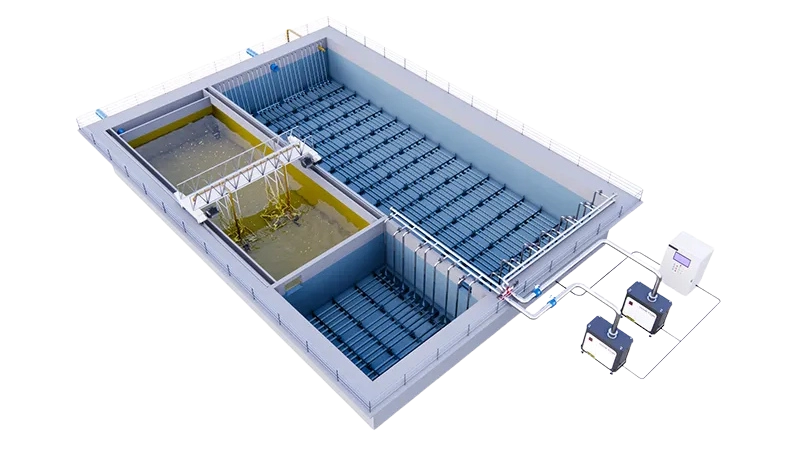
For existing treatment plants where draining the aeration tank is difficult, a liftable aeration system can provide an alternative to conventional fixed bottom-mounted diffuser grids.
Aeration modules can be positioned in the operating tank and lifted for inspection or maintenance, subject to site-specific design and safety conditions. This helps reduce the dependence on complete tank drainage during future maintenance.
Aeration Upgrade and Capacity Expansion
When an existing aeration system cannot support increased production or stricter discharge requirements, HINKTON evaluates the available tank volume, existing air supply, diffuser condition and biological oxygen demand.
Depending on the assessment, the upgrade may include additional liftable aeration modules, redistribution of the air supply, replacement of inefficient diffusers or optimization of the blower operating strategy.
Maintainable Aeration System Design
A reliable aeration system should remain maintainable after installation. HINKTON considers valve zoning, isolation, pipeline access, module lifting, membrane replacement and future expansion during the design stage.
This is especially important for paper mills operating continuously or with limited maintenance shutdown windows.
Indonesia Paper Mill Retrofit Without Draining the Aeration Tank
Challenge
The Existing Bottom-Mounted System Was Difficult to Upgrade
The customer’s wastewater treatment plant originally used a conventional bottom-mounted aeration system. As the existing treatment facility needed additional aeration capacity, the customer required a retrofit solution that would not interrupt the operation of the wastewater treatment plant.
Draining the aeration tank and stopping treatment operations would have created substantial operational difficulties. The new equipment also needed to work with the available tank conditions and existing air-supply infrastructure.
HINKTON Solution
Installing Additional Liftable Aeration During Operation
After evaluating the existing tank, air-supply conditions and installation requirements, HINKTON supplied a liftable aeration solution that could be added without draining the operating aeration tank.
The aeration modules and air-distribution arrangement were adapted to the existing facility. Installation was completed while the wastewater treatment plant remained in operation.
Stable Operation Since Installation
The retrofit was completed without shutting down the wastewater treatment process. The HINKTON liftable aeration system has continued to operate reliably since installation, while also providing improved accessibility for future inspection and maintenance.