
Municipal Wastewater Treatment Is a System Challenge
Municipal wastewater is generated by households, commercial buildings, public facilities and other urban activities. Its flow and composition may change throughout the day and across seasons, while rainfall, ·organic removal, nitrification, nutrient removal and sludge separation under these changing conditions.
The biological stage depends heavily on the performance of the aeration system. Insufficient oxygen can reduce treatment stability, while excessive or poorly controlled aeration increases energy consumption without necessarily improving effluent quality.
Common Challenges in Municipal Wastewater Treatment
Variable Flow and Organic Load
Daily peaks, rainfall and seasonal changes can cause rapid variations in wastewater flow and biological loading.
Increasing Nutrient Removal Requirements
Stable ammonia, total nitrogen and phosphorus removal requires coordinated biological design, aeration and process control.
Aging Treatment Infrastructure
Existing tanks, diffusers, blowers, pipes and instruments may no longer match current operating requirements.
Limited Capacity and Plant Footprint
Population growth and higher influent loads may require additional treatment capacity without constructing new biological tanks
Poor Sludge Settling
High SVI, sludge bulking and solids carryover can limit secondary clarifier performance and final effluent quality.
High Operating and Maintenance Cost
Energy consumption, equipment aging, diffuser maintenance and process instability can increase the total cost of plant operation.
Where Municipal Aeration Systems Lose Performance
Aeration is not only a diffuser issue. System performance depends on oxygen demand, blower selection, pipeline resistance, diffuser density, airflow distribution, process control and long-term maintenance
- High Aeration Energy Consumption
Blowers may supply more air and pressure than the biological process actually requires. Oversized equipment, inaccurate DO control and poor diffuser performance can cause unnecessary energy consumption.
- Increasing Head Loss and Diffuser Fouling
Membrane aging, scaling, biological deposits and uneven loading may increase diffuser resistance. The blower must then operate at higher pressure to maintain airflow.
- Uneven Airflow and Dissolved Oxygen Distribution
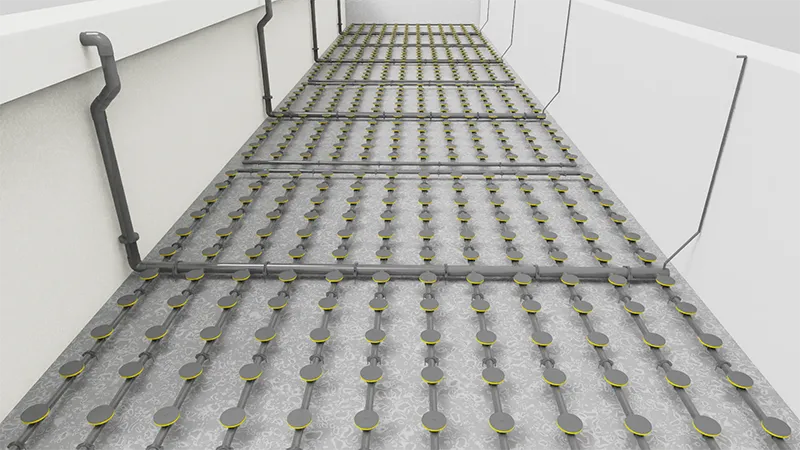
Poor grid layout, unbalanced branch pipes or inaccurate valve adjustment can create areas of excessive and insufficient aeration within the same biological tank.
Uneven DO may result in wasted air in some zones while limiting nitrification or mixing performance in others.
- Blower and Diffuser Mismatch
Replacing only the blower or only the diffusers does not guarantee system efficiency. The blower operating range must be evaluated against pipeline resistance, diffuser airflow and changing process demand.
- Limited Response to Changing Process Loads
Municipal wastewater loading changes throughout the day. A fixed airflow strategy may over-aerate during low-load periods and fail to provide sufficient oxygen during peak conditions.
Airflow zoning, reliable instrumentation and appropriate control logic are required to respond to actual process demand.
- Difficult Inspection and Maintenance
Conventional bottom-mounted aeration systems may require tank drainage or process interruption for inspection and replacement.
This can be particularly difficult for plants with limited standby capacity or biological tanks that must remain in continuous operation.
- Insufficient Aeration Capacity After Plant Expansion
When influent load or treatment requirements increase, the existing diffuser density, blower capacity and oxygen distribution may no longer meet biological demand.
Capacity expasion should therefore evaluate the biological process, aeration equipment and air supply system together.
General Recommendations for Municipal Aeration Systems
General Aeration Recommendations
Before replacing equipment, the complete aeration system should be reviewed using actual operating data.
01|Recalculate Actual Oxygen Demand
Evaluate average and peak oxygen demand using current influent loading, treatment targets, temperature and process configuration.
02|Measure the System Pressure Profile
Identify pressure loss across blowers, main headers, branch pipes, valves and diffusers instead of relying only on blower discharge pressure.
03|Check Diffuser Airflow
Confirm whether each diffuser is operating within its recommended airflow range. Excessive unit airflow may increase bubble size, resistance and membrane stress.
04|Review Diffuser Density and Layout
Evaluate whether the aeration grid provides sufficient oxygen transfer and mixing across all operating zones.
05|Match the Blower to the System
Compare the blower operating envelope with the actual system curve under minimum, normal and peak airflow conditions.
06|Improve Airflow Zoning and Control
Use appropriate valves, DO instruments and control strategies to distribute air according to the requirements of different biological zones.
07|Design for Maintenance
Consider isolation, drainage, retrieval and replacement requirements during the initial design, rather than after an aeration failure occurs.
08|Verify Performance Under Actual Conditions
Clean-water test data should be reviewed together with water depth, diffuser density, airflow, wastewater characteristics and field operating conditions.
01 Project Data Review
Review treatment capacity, influent and effluent data, tank dimensions, existing process, blower information and current operating problems.
02 Process and Oxygen Demand Assessment
Evaluate biological loading, average and peak oxygen requirements, mixing conditions and treatment bottlenecks.
03 Aeration System Diagnosis
Review blower pressure, airflow distribution, pipeline layout, diffuser condition, DO control and maintenance requirements.
04 Solution Configuration
Select suitable disc, tube or retrievable aeration systems and evaluate MBBR, IFAS or biological process upgrades where required.
05 Engineering and Equipment Integration
Develop diffuser quantities, aeration layouts, airflow zoning, equipment configurations and installation recommendations.
06 Installation and Commissioning Support
Support installation inspection, airflow testing, DO adjustment and initial system optimization.
Selected Municipal Wastewater Project Experience
1、Phase III New-Build Municipal WWTP Project
Shenyang, Northeast China
Design Capacity: 1,300,000 m³/day
Project Type: Phase III new construction
HINKTON Scope: Fine bubble disc diffusers for the biological aeration system
HINKTON supported the large-scale municipal project with aeration equipment supply and project coordination for the new biological treatment facilities.
- Large Municipal Wastewater Treatment Plant Project
Changsha, Hunan, China
Design Capacity: 600,000 m³/day
HINKTON Scope: Fine bubble tube diffusers for the biological aeration system
The project demonstrates HINKTON’s experience in tube diffuser application for large municipal wastewater treatment facilities.
Beyond these selected projects, HINKTON has accumulated extensive practical experience in municipal wastewater aeration, new plant construction, system retrofit and biological treatment support across China.