Food and beverage manufacturing generates substantial volumes of wastewater during raw-material processing, production, equipment cleaning and plant sanitation.
Depending on the product and manufacturing process, the wastewater may contain sugars, starch, proteins, fats, alcohol, organic acids, suspended solids and cleaning chemicals. These contaminants can create high COD and BOD concentrations, significant oxygen demand and considerable fluctuations in wastewater flow and organic loading.
Biological treatment is therefore widely used in food and beverage wastewater treatment plants. Within the biological process, the aeration system plays a critical role in supplying oxygen, maintaining microbial activity, supporting stable treatment performance and controlling long-term energy consumption.
HINKTON has supplied aeration equipment and supported wastewater treatment projects for food and beverage manufacturers in Sichuan, Dalian and Hubei, China. These projects involved one-meter tube diffusers, specially formulated EPDM membrane tube diffusers and disc diffusers.
Key Aeration Challenges in Food and Beverage Wastewater Treatment
High Organic Loads and Oxygen Demand
Food-processing wastewater usually contains a high concentration of biodegradable organic matter.
Although this wastewater often has relatively good biodegradability, the high organic load also means that the biological treatment system requires a reliable and continuous oxygen supply.
Insufficient aeration may lead to:
- Low dissolved oxygen levels
- Reduced microbial activity
- Unstable activated sludge performance
- Poor sludge settling
- Fluctuations in final effluent quality
- Odor and anaerobic conditions in the aeration tank
The aeration system should therefore not be designed according to average wastewater flow alone. Peak wastewater flow, maximum organic loading, MLSS concentration, water depth, treatment process and discharge requirements should also be considered.
Wastewater Fluctuations Caused by Production and Cleaning Cycles
Food and beverage plants often operate according to batch-production schedules, seasonal production cycles and regular cleaning procedures.
High-concentration process wastewater and lower-concentration cleaning wastewater may enter the treatment plant at different times. This can cause rapid changes in wastewater flow, COD concentration and actual oxygen demand.
A suitable aeration system should provide sufficient operating flexibility through:
- Aeration zoning
- Airflow adjustment
- Control valves
- Dissolved oxygen monitoring
- Blower speed control
- Proper diffuser distribution
This helps prevent oxygen shortages during peak loading while avoiding unnecessary over-aeration during periods of lower demand.
Fats, Oils and Suspended Solids
Some food-processing wastewater contains fats, proteins, raw-material particles and suspended solids.
When pretreatment performance is unstable, these substances may enter the biological tank and affect oxygen transfer, membrane condition, mixing performance and diffuser maintenance requirements.
Diffuser selection should therefore consider more than clean-water oxygen-transfer efficiency. Membrane material, diffuser opening design, operating airflow, wastewater characteristics and maintenance conditions should also be evaluated.
High Aeration Energy Consumption
Aeration is often one of the largest energy consumers in a biological wastewater treatment system.
Poor diffuser distribution, aged membranes, diffuser fouling, excessive system pressure or unsuitable airflow control may force the blowers to consume more electricity while still failing to maintain stable dissolved oxygen levels.
An effective aeration design should balance:
- Process oxygen demand
- Diffuser quantity
- Air distribution
- Pipeline pressure loss
- Operating water depth
- Diffuser resistance
- Blower airflow and pressure
- Future maintenance requirements
The objective is not simply to supply more air, but to transfer the required amount of oxygen efficiently and reliably.
HINKTON Food and Beverage Wastewater Project Experience
Food Processing Wastewater Project in Sichuan
HINKTON participated in a wastewater treatment project for a food manufacturer in Sichuan Province, China.
A total of 900 one-meter tube diffusers were supplied for the biological aeration system.
Project Information
- Location: Sichuan Province, China
- Industry: Food processing
- Product: One-meter tube diffusers
- Quantity: 900 units
- Application: Biological aeration tank
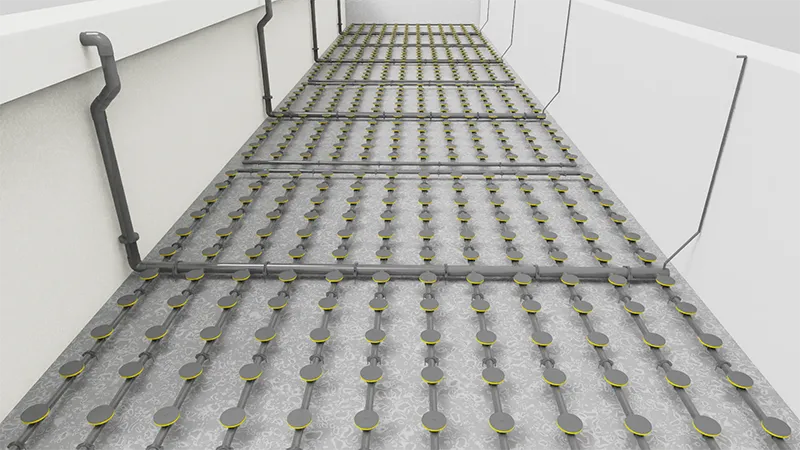
Tube diffusers provide a relatively large active membrane area and can be arranged along air-distribution branch pipes according to the tank geometry and oxygen demand.
For food-processing wastewater, a properly designed tube diffuser system can provide broad aeration coverage while supporting oxygen supply and air distribution throughout the biological tank.
In a large system containing hundreds of diffusers, the design should not focus only on the total quantity of equipment.
The following factors are also important:
- Main header sizing
- Branch-pipe arrangement
- Airflow zoning
- Valve configuration
- Airflow per diffuser
- Pipeline pressure balance
- Blower operating pressure
- Maintenance accessibility
The installation of 900 one-meter tube diffusers demonstrates HINKTON’s ability to support relatively large industrial wastewater aeration projects with both equipment supply and system-level technical coordination.
Customized EPDM Tube Diffuser Project in Dalian
For a wastewater treatment project associated with a food company in Dalian, HINKTON supplied 500 tube diffusers equipped with specially formulated EPDM membranes.
Project Information
- Location: Dalian, China
- Industry: Food processing
- Product: Tube diffusers with customized EPDM membranes
- Quantity: 500 units
- Project feature: Membrane formulation selected according to wastewater conditions
EPDM is widely used as a membrane material for wastewater aeration diffusers. However, food-processing wastewater characteristics can vary considerably.
Standard membrane formulations may not be suitable for every wastewater environment, particularly where the wastewater contains oils, cleaning chemicals, temperature variations or unusual pH conditions.
Important information for membrane selection includes:
- Oil and grease concentration
- Wastewater temperature
- Operating pH range
- Cleaning chemicals used in production
- Expected airflow per diffuser
- System operating pressure
- Required service life
- Maintenance frequency
- Potential chemical exposure
The specially formulated EPDM membrane used in this project was selected to improve compatibility with the actual wastewater and operating environment.
This project demonstrates that HINKTON can provide not only standard aeration products, but also customized membrane and product configurations for specific industrial wastewater applications.
Beverage and Distillery Wastewater Project in Hubei
HINKTON supplied 500 disc diffusers for a wastewater treatment project associated with Jing Brand Co., Ltd. in Hubei Province, China.
Jing Brand is a well-known Chinese producer of alcoholic beverages. Wastewater from alcohol and beverage manufacturing may contain alcohol, sugars, organic acids, grain residues, suspended solids and cleaning wastewater.
These characteristics can create substantial organic loading and significant oxygen demand in the biological treatment process.
Project Information
- Location: Hubei Province, China
- Industry: Alcoholic beverage production
- Product: Disc diffusers
- Quantity: 500 units
- Application: Biological wastewater treatment
Disc diffusers provide a modular aeration arrangement and can be distributed according to the tank floor area and oxygen demand in different treatment zones.
For beverage and distillery wastewater, the aeration system must respond to variations in production schedules and wastewater loading.
A properly designed disc diffuser system can support this requirement through:
- Flexible diffuser density
- Aeration zoning
- Individual branch-pipe control
- Adjustable air supply
- Standardized diffuser replacement
- Balanced air distribution
The use of 500 disc diffusers in this project further demonstrates HINKTON’s experience in aeration applications for beverage and alcohol-production wastewater.
Tube Diffusers or Disc Diffusers: Which Is More Suitable?
There is no single diffuser type that is suitable for every food and beverage wastewater treatment project.
Tube diffusers and disc diffusers each offer specific advantages. The final selection should be based on wastewater characteristics, tank geometry, oxygen demand, air-distribution requirements and future maintenance conditions.
Tube Diffusers
Tube diffusers provide a relatively large membrane area and can be installed in rows along branch air pipes.
They are often suitable for projects with:
- Large rectangular aeration tanks
- High airflow requirements
- Broad aeration coverage
- Long branch-pipe arrangements
- Relatively uniform oxygen demand
- A preference for fewer diffuser connection points
The Sichuan project using 900 one-meter tube diffusers and the Dalian project using 500 customized EPDM tube diffusers are examples of this type of application.
Disc Diffusers
Disc diffusers provide a modular layout and can be arranged at different densities in different tank zones.
They are often suitable for projects with:
- Zoned aeration requirements
- Grid-based tank layouts
- Uneven oxygen demand
- Standardized diffuser replacement
- Flexible system expansion
- Multiple operating zones
The Hubei beverage project using 500 disc diffusers demonstrates the application of this configuration in the biological treatment of beverage and distillery wastewater.
Aeration System Design Is More Than Diffuser Quantity
The number of diffusers is only one part of a complete aeration-system design.
Whether a project uses tube diffusers, disc diffusers or another aeration technology, the following factors should be evaluated.
Actual Process Oxygen Demand
Oxygen demand should be calculated according to:
- Daily and peak wastewater flow
- Influent COD and BOD
- Ammonia nitrogen
- Treatment process
- Sludge concentration
- Required effluent quality
- Operating temperature
- Peak organic loading
Tank Dimensions and Water Depth
Tank length, width, effective water depth, volume and floor configuration affect:
- Diffuser quantity
- Diffuser spacing
- Bubble contact time
- Air-distribution layout
- Operating pressure
- Oxygen-transfer performance
Air Distribution
Large aeration systems require correctly sized main headers, branch pipes, control valves and aeration zones.
An unbalanced system may deliver excessive airflow to diffusers located close to the blower while providing insufficient airflow to more distant areas.
Hydraulic and pressure-balance considerations are therefore essential.
Membrane Material Compatibility
Membrane selection should consider:
- Wastewater temperature
- pH range
- Oil and grease
- Cleaning chemicals
- Chemical exposure
- Required flexibility
- Fouling conditions
- Expected operating life
Depending on the wastewater characteristics, the project may require standard EPDM, specially formulated EPDM, silicone or another suitable membrane material.
Blower Flow and Pressure
The aeration equipment must be matched with the blower system.
The required blower pressure should account for:
- Water depth
- Pipeline pressure loss
- Valve pressure loss
- Diffuser operating resistance
- Fouling allowance
- Required airflow range
Retaining an existing blower is possible only when its airflow, discharge pressure and operating range are suitable for the new aeration configuration.
Future Maintenance
Fixed bottom-mounted aeration systems may require tank drainage before inspection or replacement.
For new projects, maintenance requirements should be considered during the initial design stage through:
- Airflow zoning
- Isolation valves
- Accessible branch pipes
- Standardized connections
- Maintenance walkways
- Replaceable components
For existing plants that cannot easily stop production or drain the aeration tank, HINKTON can also evaluate the feasibility of a liftable aeration solution.
HINKTON Solutions for Food and Beverage Wastewater
HINKTON provides more than individual diffusers. We support the selection and engineering of aeration systems for the biological treatment stage of food and beverage wastewater projects.
Our services and products include:
- Tube diffuser systems
- Disc diffuser systems
- Hose diffuser systems
- Liftable aeration systems
- Standard EPDM membranes
- Customized EPDM membranes
- Silicone membrane options
- Aeration-system layout design
- Air-header and branch-pipe design
- Valve zoning and airflow distribution
- Existing blower compatibility assessment
- New wastewater treatment plant design support
- Existing aeration-system retrofit support
- Installation and commissioning guidance
- Maintenance recommendations
From 900 one-meter tube diffusers for a food-processing project in Sichuan, to 500 customized EPDM tube diffusers for a food project in Dalian, and 500 disc diffusers for a beverage project in Hubei, HINKTON has developed practical experience across different food and beverage wastewater applications.
The use of different diffuser types in these projects also demonstrates an important principle:
Food and beverage wastewater aeration systems should be designed according to actual wastewater characteristics, tank conditions, oxygen demand and maintenance requirements rather than using a single standard configuration.
Looking for an Aeration Solution for Food and Beverage Wastewater?
Whether your project involves a new wastewater treatment plant, replacement of an existing diffuser system or expansion of biological treatment capacity, HINKTON can provide a project-specific aeration assessment.
Send us your wastewater data, tank drawings and existing blower information to receive a suitable aeration-system recommendation.