Rubber Wastewater Treatment & Aeration Solutions
Rubber processing wastewater can place high and variable oxygen demand on biological treatment systems.
HINKTON provides fine bubble aeration and retrofit solutions designed around wastewater characteristics,
tank conditions, oxygen demand and existing air supply.
Why Rubber Processing Wastewater Requires Stable Aeration
Wastewater characteristics vary between natural rubber processing,
synthetic rubber production and rubber product manufacturing.
Biological treatment performance depends on how effectively the system
responds to changing organic and nitrogen loads.
High Organic Loading
Latex residues, rubber particles, oils, surfactants and organic
compounds can increase biological oxygen demand and affect sludge performance.
- High COD and BOD loads
- Rubber and latex residues
- Oils and surfactants
- Chemical additives
Nitrogen Removal
Some rubber processing streams may contain elevated nitrogen loads.
Stable nitrification requires suitable dissolved oxygen, sludge retention
and microbial activity.
- Stable dissolved oxygen
- Adequate sludge retention time
- Reliable oxygen distribution
- Healthy nitrifying biomass
Variable Wastewater Loads
Production schedules and batch discharges can cause rapid changes in
wastewater flow, organic loading and chemical composition.
- Flow fluctuations
- Changing COD load
- Production discharge peaks
- Variable oxygen demand
Aeration Is More Than Supplying Air
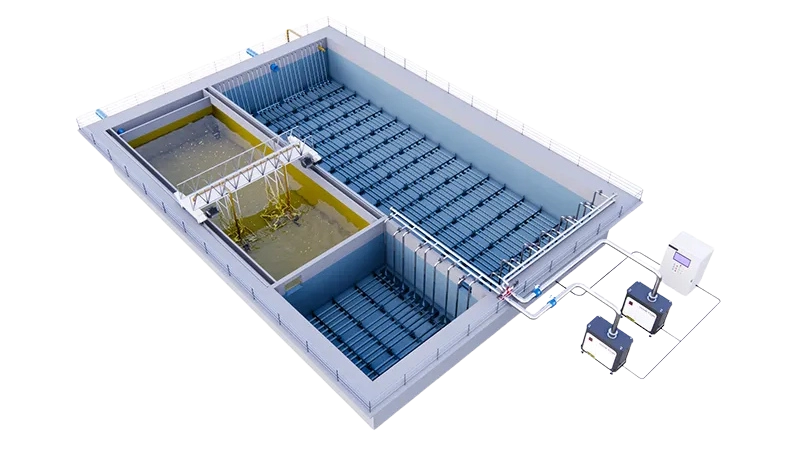
Rubber wastewater aeration should be evaluated as part of the biological
treatment system. Oxygen demand, water depth, diffuser layout, blower
capacity and actual operating conditions all affect performance.
Maintain Stable Oxygen Supply
Aeration must support COD oxidation, microbial growth and nitrification
during both normal operation and peak loading periods.
Support Biological Stability
Appropriate air distribution helps avoid low-oxygen zones and provides
more stable conditions for activated sludge and nitrifying bacteria.
Optimize Aeration Energy
Diffuser performance, airflow distribution, operating pressure and blower
control should be evaluated together to reduce unnecessary air supply.
Aeration Options for Rubber Wastewater Treatment
The suitable diffuser configuration depends on tank geometry,
wastewater characteristics, airflow requirements, maintenance strategy
and whether the project is new construction or retrofit.
Disk-X® Fine Bubble Disc Diffusers
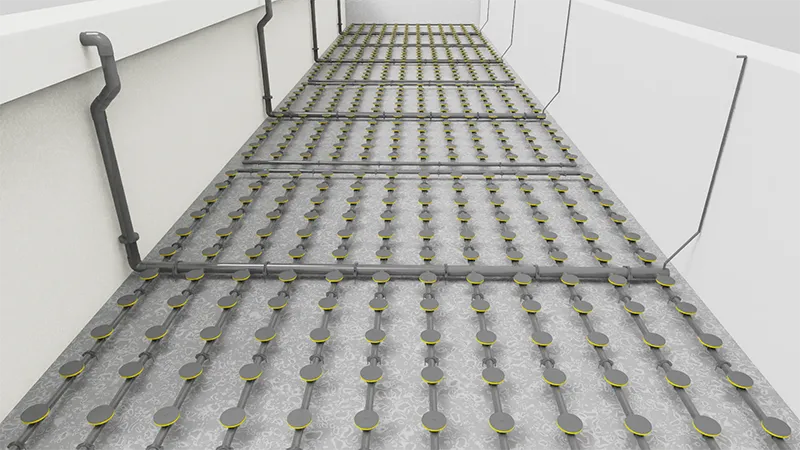
Suitable for conventional activated sludge systems and large biological
treatment tanks requiring efficient and evenly distributed fine bubble aeration.
- Efficient oxygen transfer
- Multiple membrane options
- Flexible diffuser density
Fine Bubble Tube Diffusers
Suitable for industrial wastewater tanks where longer aeration coverage
and flexible diffuser arrangement are required.
- Long aeration coverage
- Flexible installation layout
- Suitable for industrial applications
Retro-X® Retrievable Aeration
Designed for existing wastewater treatment plants where conventional
bottom-mounted aeration equipment is difficult to access or maintain.
- Retrievable configuration
- Reduced dependence on tank drainage
- Suitable for upgrade projects
Aeration Retrofit for Rubber Wastewater Plants
Long-term operation can gradually reduce aeration efficiency.
Before replacing equipment, HINKTON evaluates the existing system
to determine whether the main limitation comes from diffusers,
airflow distribution, operating pressure or blower capacity.
Review diffuser condition, blower capacity, pressure,
tank layout and current operating problems.
Evaluate airflow requirement, distribution balance and
available blower capacity.
Improve diffuser arrangement, aeration zones,
air piping and maintenance access.
Select suitable disc, tube or retrievable aeration
configurations according to site conditions.
Rubber Wastewater Treatment Applications
Natural Rubber Processing
Wastewater may contain high biodegradable organic loads,
latex residues and nitrogen compounds.
Synthetic Rubber Manufacturing
Complex organic compounds, additives and variable production
conditions can create changing oxygen demand.
Rubber Product Manufacturing
Oil, suspended solids and chemical residues may affect
biological treatment and aeration system performance.
From Wastewater Data to Aeration Configuration
HINKTON does not select diffusers only by product size.
Aeration recommendations are developed around the actual biological
process and operating conditions.
Wastewater Review
COD, ammonia, treatment capacity, process type and load variation.
Tank Evaluation
Tank dimensions, water depth, biological zones and existing layout.
Air Supply Assessment
Required airflow, blower capacity, operating pressure and distribution.
System Configuration
Diffuser selection, layout, piping concept and technical documentation.
Improve Your Rubber Wastewater Aeration System
Share your treatment capacity, wastewater characteristics,
tank dimensions and existing aeration information.
HINKTON can help evaluate a suitable aeration configuration
for new or retrofit projects.
Treatment Capacity
Tank Dimensions
Water Depth
Existing Blower Data
Rubber Wastewater Aeration FAQ
Why is aeration important in rubber wastewater treatment?
Aeration supplies oxygen for biological COD removal, microbial activity
and nitrification. Because rubber processing wastewater can have variable
organic loads, stable oxygen supply is important for maintaining biological
treatment performance.
Which diffuser is suitable for rubber wastewater?
The selection depends on wastewater characteristics, oxygen demand,
water depth, tank geometry, airflow requirement and maintenance conditions.
Disc, tube and retrievable aeration systems can all be considered depending
on the application.
Can an existing rubber wastewater aeration system be upgraded?
Yes. Existing systems can be evaluated based on diffuser condition,
blower capacity, operating pressure, airflow distribution and available
tank space. The upgrade may include diffuser replacement, airflow
redistribution or a retrievable aeration configuration.
What information is needed for aeration system selection?
Useful information includes wastewater flow, COD and ammonia loading,
biological process, tank dimensions, water depth, existing blower data,
airflow requirements and project drawings if available.