Slaughterhouse & Meat Processing Wastewater Aeration
Engineered aeration solutions for biological wastewater treatment
exposed to high organic loads, fats, proteins and fluctuating
production conditions.
HINKTON helps wastewater projects achieve reliable oxygen transfer,
balanced airflow distribution and practical long-term operation.
Variable Oxygen Demand
FOG Challenges
Biological Treatment
Aeration System
Biological Treatment Must Respond to More Than Wastewater Flow
Slaughterhouse and meat processing wastewater can change
significantly during production, washing and cleaning cycles.
These variations directly affect biological oxygen demand and
aeration-system operation.
01
Blood & Proteins
High concentrations of biodegradable organic matter can create
substantial BOD and COD loads, increasing the oxygen demand of
the biological treatment process.
02
Fats, Oils & Grease
Residual FOG entering the biological stage may influence oxygen
transfer, sludge behavior and diffuser condition. Effective
upstream pretreatment remains important.
03
Production Fluctuation
Slaughtering schedules, batch production and washdown periods
can create changing hydraulic and pollutant loads throughout
the operating day.
04
Nitrogen Demand
Protein-rich wastewater may contribute significant nitrogen
loading. Where nitrification is required, aeration must support
both organic removal and ammonia oxidation.
HINKTON Focuses on the Biological Treatment Stage
Pretreatment reduces solids and grease before biological treatment.
HINKTON focuses on the aeration stage, where oxygen transfer,
airflow distribution and system pressure directly affect biological
performance.
Screening
Remove coarse solids and production residues.
FOG Removal & Equalization
Reduce grease and buffer hydraulic or pollutant fluctuations.
03 · HINKTON FOCUS
Biological Treatment & Aeration
Deliver oxygen according to biological demand while maintaining
appropriate airflow distribution and operating pressure.
Clarification & Polishing
Separate biomass and complete further treatment where required.
The actual treatment train depends on influent characteristics,
plant configuration and discharge requirements. HINKTON primarily
provides aeration equipment and engineering support for the
biological treatment stage.
Choose the Aeration Configuration Around the Plant — Not the Product
Diffuser selection should consider oxygen requirement, basin
geometry, wastewater characteristics, operating airflow and
maintenance conditions. Different projects may require different
aeration configurations.
FIXED FINE-BUBBLE
Disk-X®
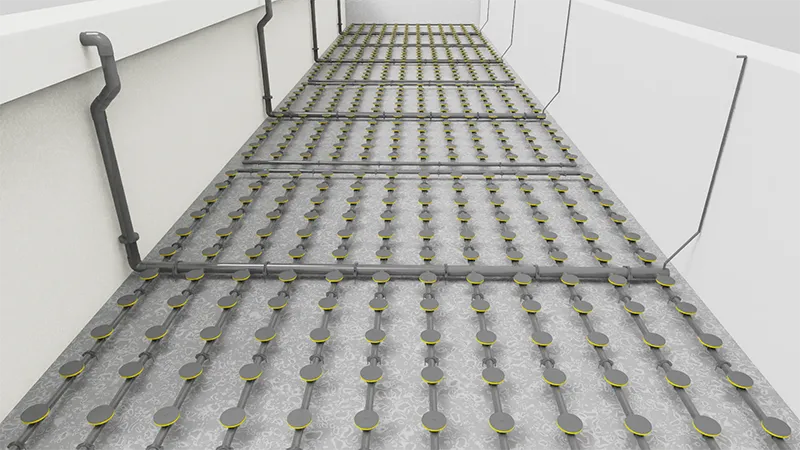
Disc diffuser systems for biological tanks requiring
fine-bubble oxygen transfer and distributed aeration coverage.
- 7 / 9 / 12 inch
- EPDM or silicone
- UPVC / SS304 / SS316 piping options
New-build or conventional fixed-grid retrofit projects
FLEXIBLE LAYOUT
Tube Diffusers
Fine-bubble tube diffuser configurations provide another
option where basin geometry, airflow distribution or
installation arrangement favors tubular aeration.
- Industrial wastewater applications
- Multiple piping configurations
- Project-specific diffuser density
Biological tanks requiring flexible diffuser arrangement
RETRIEVABLE AERATION
Retro-X®
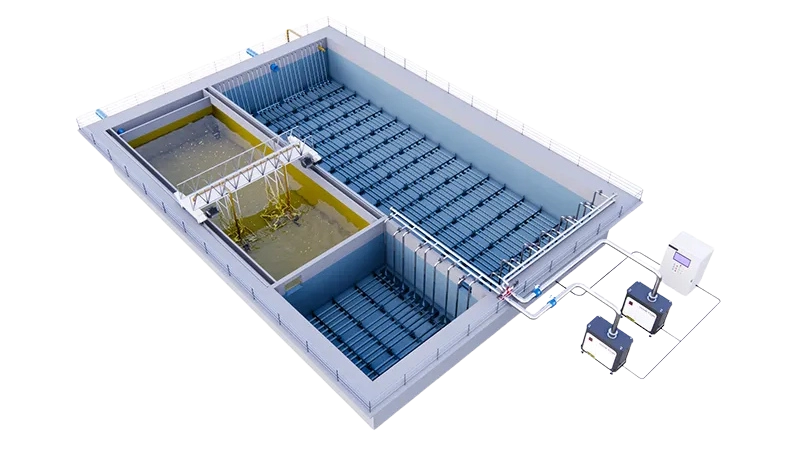
Retrievable fine-bubble aeration for selected retrofit
applications where easier access to aeration equipment can
reduce dependence on complete tank drainage.
- Existing plant retrofit
- Accessible aeration modules
- Maintenance-oriented configuration
Operating plants where shutdown and maintenance access matter
From Wastewater Load to Aeration-System Design
HINKTON does not select aeration equipment only by diffuser
diameter or nominal airflow. The aeration system is evaluated
together with the biological process and actual operating conditions.
Wastewater Load
Flow, COD, BOD, ammonia and operating variation.
Oxygen Requirement
Biological demand for carbon oxidation and nitrification.
Tank Geometry
Water depth, basin dimensions and treatment zones.
Diffuser Layout
Type, quantity, spacing and coverage.
Air Distribution
Operating airflow and distribution between zones.
Pressure Check
Diffuser pressure, piping losses and blower integration.
Food Processing Wastewater Aeration Applications
Related industrial applications demonstrate HINKTON’s experience
supplying aeration equipment for food and beverage biological
wastewater treatment systems.
Sichuan, China
1 m tube diffusers.
Dalian, China
EPDM tube diffusers.
Hubei, China
fine-bubble disc diffusers.
These projects are presented as relevant food and beverage
wastewater aeration experience and are not identified as
slaughterhouse references unless specifically stated.
What Do We Need to Review Your Aeration System?
Basic wastewater, process and basin information is normally
enough to begin an initial technical discussion.
Slaughterhouse Wastewater Aeration FAQ
Common questions when evaluating an aeration system for
slaughterhouse and meat processing wastewater.
What aeration system is suitable for slaughterhouse wastewater?
wastewater characteristics, tank geometry, oxygen demand,
operating airflow and maintenance conditions. Fine-bubble disc
and tube diffusers are commonly considered for biological
treatment, while selected retrofit projects may use retrievable
aeration systems.
Does grease affect fine-bubble aeration?
conditions and diffuser surfaces. Upstream screening, grease
separation or flotation can therefore be important before
wastewater enters the biological treatment stage.
Is wastewater flow enough to determine aeration capacity?
nitrogen-removal requirements, water temperature, biological
process, operating depth and required dissolved oxygen conditions
can all influence oxygen demand and airflow requirements.
Can an existing aeration system be upgraded?
wastewater load and basin configuration can be reviewed to
determine whether diffuser replacement, airflow redistribution
or another aeration configuration may be appropriate.
Planning a Slaughterhouse or Meat Processing Wastewater Project?
Send us your wastewater data, treatment capacity and basin
information. HINKTON can review the biological aeration
requirements and recommend an appropriate aeration configuration.